
Supreme Court Uses its Imagination and Holds that Designs on Cheerleading Uniforms are Eligible for Copyright Protection
Authors: Scott Lydon and Christopher Messina.
In a 6-2 decision with Justice Thomas delivering the majority opinion, the Supreme Court held in Star Athletica LLC v. Varsity Brands, Inc., Varsity Spirit Corporation, and Varsity Spirit Fashions & Supplies, Inc., No. 15-866 that “pictorial, graphic, or sculptural features” as defined in 17 U.S.C. § 101 are eligible for copyright protection only if the feature:
1. can be perceived as a two- or three-dimensional work of art separate from the useful article; and
2. would qualify as a protectable pictorial, graphic, or sculptural work—either on its own or fixed in some other tangible medium of expression—if it were imagined separately from the useful article into which it is incorporated.
Because Varsity Brands’ uniform decoration designs would qualify as two-dimensional works of art if conceptually separated from the uniform and applied in another medium, such a painter’s canvas, they are protectable by copyright. Accordingly, while industrial designs, the uniforms themselves or other utility focused articles, like shovels, are not eligible for copyright protection—the combination, positioning and arrangement of the surface decorations, including chevrons, lines curves, stripes, angles, diagonals, inverted chevrons, coloring and shapes, satisfy the above eligibility test for copyright protection. The majority opinion also distinguished the protectable designs from the non-protectable shape, cut, and dimensions of a cheerleading uniform.
In concurring in the judgement but not the opinion, Justice Ginsburg held that the designs at issue are not designs of useful articles but rather copyrightable pictorial or graphic works reproduced on useful articles.
In dissent, Justice Breyer, joined by Justice Kennedy, expressed that Varsity Brands’ designs cannot be perceived as two- or three-dimensional works of art separate from the useful cheerleader uniform because the design elements make up the shape of the uniform. For articles where the form and function are inseparable, a design patent, and not copyright, would be a more appropriate means of protection.
A key takeaway from this case is that designs incorporated into useful articles can qualify for copyright protection. This may result in increased efforts to seek copyright protection for designs in the fashion and apparel industry.
Federal Trade Secret Protection – A New IP Regime
Authors: Scott Lydon and Christopher Messina.
Until now, trade secret cases have exclusively been decided under the laws of each state. However, the Defend Trade Secrets Act of 2016 (“DTSA”), signed into law today by President Obama, provides new federal protection for trade secrets. Going forward, this new federal protection should result in a national standard providing greater predictability of legal outcomes for trade secret cases.
While the new DTSA does not preempt existing state law, it provides additional federal protections in the form of ex-parte seizure orders, injunctive relief and monetary damages. The DTSA also provides safeguards against claims made in bad faith, and immunity to parties who disclose a trade secret to the government or an attorney for reporting a suspected violation of law.
Supreme Court Grants Review in Two IP Cases
Authors: Scott Lydon and Christopher Messina.
The Supreme Court decided to consider the following two intellectual property cases: (1) the patent case SCA Hygiene Products v. First Quality Baby Products, to determine whether latches remains a defense under the Patent Act; and (2) the copyright case Star Athletica LLC v. Varsity Brands, Inc., to determine whether stripes, chevrons, zigzags and color blocks on apparel can be protected by copyright law.
Recent Supreme Court Oral Arguments
Authors: Scott Lydon and Christopher Messina.
The Supreme Court heard oral arguments in Cuozzo Speed Technologies, LLC v. Michelle K. Lee, No. 15-446 on April 25th.
At issue is whether the Patent Trial and Appeal Board (“PTAB”) is correctly construing claims in an issued patent using their broadest reasonable interpretation rather than their plain and ordinary meaning. The narrower plain and ordinary meaning standard is used when construing claims in District Court litigation. A second issue, as a matter of separation of powers, is whether the Federal Circuit correctly held that PTAB decisions to institute inter partes review (IPR) are not judicially reviewable, even if the PTAB exceeds its statutory authority in instituting such proceedings. Currently, only a final written decision of the PTAB is reviewable by the Federal Circuit. 35 U.S.C. § 141(c).
MP&H and The Connecticut Invention Convention
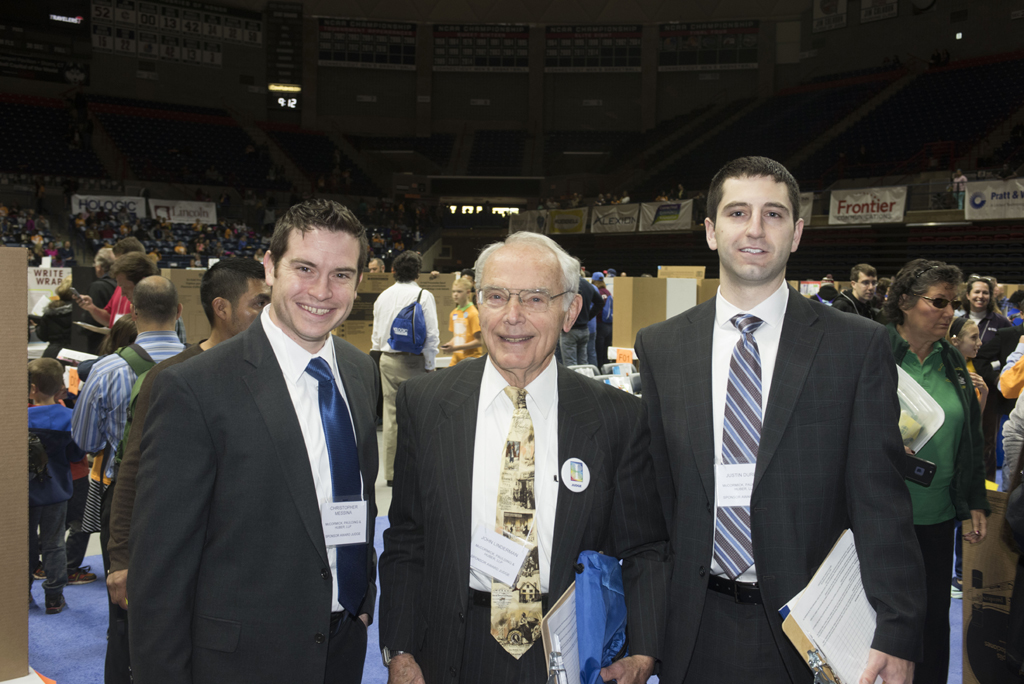
McCormick, Paulding & Huber is proud to be a sponsor of The Connecticut Invention Convention (CIC).
The CIC is an organization that encourages critical thinking and creativity in grade schools throughout the State of Connecticut and beyond. Each year students are requested to make an invention as a school project. The top inventors from the participating schools attend a state convention to display their inventions in a friendly competition and receive awards recognizing their achievements.
[wc_row][wc_column size=”one-half” position=”first”]
[/wc_column][wc_column size=”one-half” position=”last”]
[/wc_column][/wc_row]
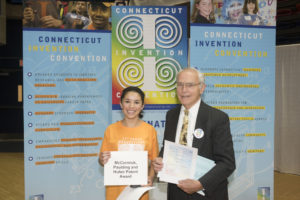
McCormick, Paulding & Huber has participated in the CIC since its inception over 30 years ago by providing judges for the competition and awarding a free patent search, patent filing and prosecution of a patent application for the recipient as pictured above. MPH has procured patents for multiple CIC inventors, some of whom have started businesses based upon their invention.